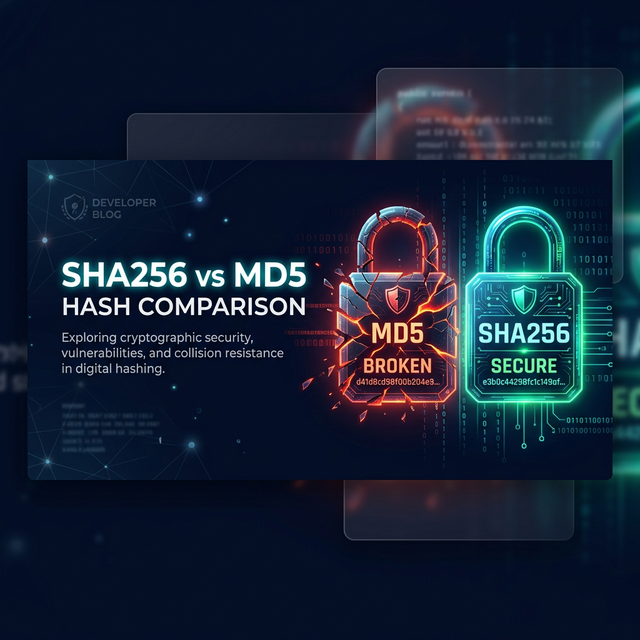
Hash algorithms are the backbone of data integrity, password storage, and digital signatures. But with multiple options available — MD5, SHA1, SHA256, SHA512 — which one should you choose? In this article, we compare SHA256 and MD5 head-to-head to help you make the right decision.
What is Hashing?
A hash function takes input data of any size and produces a fixed-size output (the "digest" or "hash"). Key properties of a good hash function include:
- Deterministic — same input always produces the same hash
- Fast computation — quick to compute for any input
- Pre-image resistant — infeasible to reverse-engineer the input from the hash
- Collision resistant — extremely unlikely for two different inputs to produce the same hash
- Avalanche effect — small input changes produce drastically different hashes
MD5 at a Glance
MD5 (Message Digest Algorithm 5) was designed by Ronald Rivest in 1991. It produces a 128-bit (16-byte) hash, typically represented as a 32-character hexadecimal string:
Input:  "Hello, World!"
MD5: 65a8e27d8879283831b664bd8b7f0ad4ExampleIn 2004, researchers demonstrated practical collision attacks against MD5. In 2012, the Flame malware exploited MD5 collisions to forge Microsoft certificates. Never use MD5 for security-critical applications.
SHA256 at a Glance
SHA256 (Secure Hash Algorithm 256-bit) is part of the SHA-2 family, designed by the NSA. It produces a 256-bit (32-byte) hash — twice the length of MD5:
Input:  "Hello, World!"
SHA256: dffd6021bb2bd5b0af676290809ec3a5
        3191dd81c7f70a4b28688a362182986fExample
Head-to-Head Comparison
| Property | MD5 | SHA256 |
|---|---|---|
| Output Size | 128 bits (32 hex chars) | 256 bits (64 hex chars) |
| Speed | Very fast (~600 MB/s) | Fast (~250 MB/s) |
| Collision Resistance | ❌ Broken (known collisions) | ✅ No known collisions |
| Pre-image Resistance | ⚠️ Weakened | ✅ Strong |
| Industry Standard | ❌ Deprecated for security | ✅ Recommended (NIST, FIPS) |
| Use in TLS/SSL | ❌ Banned since 2015 | ✅ Required for TLS 1.2+ |
When to Use MD5 (Still Valid)
Despite being cryptographically broken, MD5 is still useful for non-security purposes:
- File checksums — quick verification that a file downloaded correctly (when collision attacks aren't a concern)
- Cache keys — generating unique keys for caching layers
- Data deduplication — detecting duplicate records where security isn't a factor
- Legacy system compatibility — interacting with older systems that require MD5
When to Use SHA256 (Always for Security)
- Password hashing — combined with salt and key stretching (bcrypt/Argon2 preferred)
- Digital signatures — code signing, certificate chains, JWT tokens
- Blockchain — Bitcoin and Ethereum use SHA256 for proof-of-work
- HMAC authentication — API request signing with HMAC-SHA256
- Data integrity — verifying downloads, backups, and file transfers
Code Examples
C# — Generate Both Hashes
using System.Security.Cryptography;
using System.Text;

string input = "Hello, World!";
byte[] bytes = Encoding.UTF8.GetBytes(input);

// MD5
string md5 = Convert.ToHexString(MD5.HashData(bytes));
// Output: 65A8E27D8879283831B664BD8B7F0AD4

// SHA256
string sha256 = Convert.ToHexString(SHA256.HashData(bytes));
// Output: DFFD6021BB2BD5B0AF676290809EC3A5...C#
JavaScript — Web Crypto API
async function sha256(message) {
    const encoder = new TextEncoder();
    const data = encoder.encode(message);
    const hash = await crypto.subtle.digest('SHA-256', data);
    return Array.from(new Uint8Array(hash))
        .map(b => b.toString(16).padStart(2, '0'))
        .join('');
}

// Note: Web Crypto API doesn't support MD5
// (by design — it's insecure)JavaScriptNeither MD5 nor SHA256 alone is suitable for password hashing — they're too fast, making brute-force attacks feasible. Use bcrypt, Argon2, or PBKDF2 which include key stretching and built-in salting.
HMAC: Adding a Secret Key
For API authentication, use HMAC (Hash-based Message Authentication Code). HMAC combines a hash function with a secret key to verify both integrity and authenticity:
using System.Security.Cryptography;
using System.Text;

string message = "api_request_payload";
string secret = "your_api_secret_key";

byte[] key = Encoding.UTF8.GetBytes(secret);
byte[] data = Encoding.UTF8.GetBytes(message);

string hmac = Convert.ToHexString(
    HMACSHA256.HashData(key, data)
);C#Try Hash Generator
Generate MD5, SHA256, SHA512 hashes and HMAC digests instantly. Free, no sign-up.
Open Hash Generator →Conclusion
SHA256 is the clear choice for any security-related hashing. Its larger output space (2256 vs 2128) and unbroken collision resistance make it the industry standard. MD5 still has value for non-security checksums and legacy compatibility, but should never be trusted for cryptographic purposes.
Need to generate hashes quickly? Use Polymorpher's free Hash Generator — it supports MD5, SHA1, SHA256, SHA384, SHA512, and HMAC with custom keys.